
skew
Syntax
skew(X, [biased=true])
Details
Return the skewness of X. The calculation skips null values.
When biased=true:
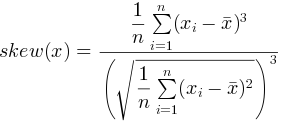
When biased=false:

If X is a matrix, calculate the skewness of each column of X and return a vector.
If X is a table, calculate the skewness of each column of X and return a table.
The skew function also supports querying partitioned tables and
distributed tables with bias correction.
skew functions using the Fisher-Pearson coefficient, but they
differ in several respects. DolphinDB ignores NULL values during computation, while
SciPy allows you control this behavior explicitly through the nan_policy
parameter. SciPy also provides the keepdims parameter, which preserves the
original array dimensions after computation.Parameters
X is a vector/matrix.
biased (optional) is a Boolean value indicating whether the result is biased. The default value is true, meaning the bias is not corrected.
Returns
A DOUBLE scalar, vector, or table.
Examples
Please note that as the example below uses a random number generator, the result is slightly different each time it is executed.
x=norm(0, 1, 1000000);
skew(x);
// output: -0.00124

x[0]=100;
skew(x);
// output: 0.983656

m=matrix(1..10, 1 2 3 4 5 6 7 8 9 100);
m;| #0 | #1 |
|---|---|
| 1 | 1 |
| 2 | 2 |
| 3 | 3 |
| 4 | 4 |
| 5 | 5 |
| 6 | 6 |
| 7 | 7 |
| 8 | 8 |
| 9 | 9 |
| 10 | 100 |
skew(m);
// output: [0,2.630083823883674]