
kurtosis
Syntax
kurtosis(X, [biased=true])
Details
Return the kurtosis of X. The calculation skips null values.
-
when biased =true:
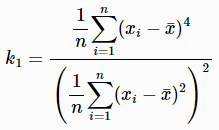
-
when biased=false:

If X is a matrix, calculate the skewness of each column of X and return a vector.
If X is a table, calculate the skewness of each column of X and return a table.
kurtosis also supports querying partitioned tables and distributed
tables with bias correction.
Function kurtosis in DolphinDB returns a biased result by default
(biased = true), while in pandas and Excel it is unbiased estimation, and
the kurtosis value 3 of the normal distribution is subtracted.
Refer to the following example, you can make the kurtosis results of DolphinDB consistent with that of pandas and excel:
// python
m = [1111, 323, 43, 51]
df = pandas.DataFrame(m)
y = df.kurt()
// output: 2.504252

// dolphindb
m=matrix(1111 323 43 51)
kurtosis(m, false) - 3
// output: 2.5043
Parameters
X is a vector/matrix.
biased is a Boolean value indicating whether the result is biased. The default value is true, meaning the bias is not corrected.
Returns
A DOUBLE scalar/vector/table.
Examples
Please note that as the example below uses the random number generator norm, the result is slightly different each time it is executed.
x=norm(0, 1, 1000000);
kurtosis(x);
// output: 3.000249

x[0]=100;
kurtosis(x);
// output: 100.626722

m=matrix(1..10, 1 2 3 4 5 6 7 8 9 100);
m;| #0 | #1 |
|---|---|
| 1 | 1 |
| 2 | 2 |
| 3 | 3 |
| 4 | 4 |
| 5 | 5 |
| 6 | 6 |
| 7 | 7 |
| 8 | 8 |
| 9 | 9 |
| 10 | 100 |
kurtosis(m);
// output: [1.775757575757576,7.997552566718839]